
Spine Decompression Surgery
Many potential patients for surgery are a concern to Know about Spinal Decompression surgery cost In India? The Average cost of Spinal Decompression Surgery In India usually starts 5500 USD however, it may go up to as much as 12,000. It depends on the hospital charges and the fee charged by the surgeon. This price usually does not cover post-operational therapy and medicine. Additional costs also involve the diagnostics before the surgery and pre-operational consultations.
Get Opinion From Doctor
When the spinal cord is compressed, it can happen anywhere from the neck (cervical spine) to the lower back (lumbar spine). The spinal cord and its internal nerves can become compressed due to degenerative changes brought on by aging, hernias, trauma, injuries, infections, cancer, aberrant bone development, and hematomas (blood). The patient may have symptoms including limb numbness, neck or back discomfort, loss of foot feeling, or poor hand-eye coordination.
Spine Decompression Surgery Cost in India is much more affordable when compared to that of other developed nations like the US, America, etc. The proficiency of the orthopedic surgeon as well as the cutting-edge medical technology utilized at the top Indian hospitals plays a role in the success of spinal/spine decompression surgery in India.
What is Spine Decompression Surgery
A surgical procedure known as spinal decompression surgery can be carried out either by open surgery, minimally invasive spine surgery, or endoscopic spine surgery (ESS). The symptoms of spinal cord compression, which aggravates the nerves, can be alleviated by a number of methods.
Several of the methods include
There are several types of Spinal decompression surgery:
- Laminectomy:- is the removal of the entire bony lamina, a portion of the enlarged facet joints, and the thickened ligaments overlying the spinal cord and nerves.
- Laminotomy:- is the removal of a small portion of the lamina and ligaments, usually on one side. Using this method the natural support of the lamina is left in place, decreasing the chance of spinal instability. Sometimes an endoscope may be used, allowing for a smaller, less invasive incision.
- Foraminotomy:- is the removal of bone around the neural foramen – the canal where the nerve root exits the spine. This method is used when disc degeneration has caused the height of the foramen to collapse and pinch a nerve.
- Laminoplasty:- is the expansion of the spinal canal by cutting the laminae on one side and swinging them open like a door. It is used only in the neck (cervical) area.
- Discectomy:- is the removal of a portion of a bulging or degenerative disc to relieve pressure on the nerves.
In some cases, spinal fusion may be done at the same time to help stabilize sections of the spine treated with laminectomy. Fusion uses a combination of bone graft, screws, and rods to connect two separate vertebrae together into one new piece of bone. Fusing the joint prevents the spinal stenosis from recurring and can help eliminate pain from an unstable spine.
Who Needs a Spinal Decompression Surgery?
Spinal decompression surgery is recommended in patients suffering from spinal stenosis. Spinal stenosis is a condition in which there is narrowing of the spinal canal which can cause chronic pain, numbness, and muscle weakness in the arms or legs. This condition mainly affects the elderly people and is mostly caused by degenerative changes that result in enlargement of the facet joints and thickening of the ligaments.
You may be a candidate for Spinal decompression Surgery if you have:
- significant pain, weakness, or numbness in your leg or foot
- leg pain worse than back pain
- not improved with physical therapy or medication
- difficulty walking or standing that affects your quality of life.
What are the Benefits of Spinal Decompression Surgery In India?
There are many benefits to minimally invasive spinal decompression surgery. These include:
- Short recovery time
- Small incision less than an inch
- Outpatient procedure that
- takes about 30-60 minutes
- Less damage to muscles
- Decreased need for pain medications.
Diagnosis for spinal decompression surgery
If you have the symptoms of spinal decompression Surgery (stenosis), your Surgeon will start by taking a medical history, performing a physical exam, and observing your movements. Your Surgeon may also order tests to confirm a suspected diagnosis, such as:
- Blood tests
- X-ray, MRI scan, or CT scan to view images of your spine
- electromyogram to check the health of spinal nerves
- bone scan to look for damage or growths in your spine
What are the risks of spinal decompression surgery?
The risks associated with spinal decompression surgery include:
- Infection
- Bleeding
- Blood clots
- Nerve or tissue damage
- Allergic reaction to anesthesia
- Paralysis
- Damage to the surrounding
- soft tissue
- Deep Vein Thrombosis (DVT)
- Bone graft migration
What is included in the cost of Spine Decompression Surgery?
The cost of Spine Decompression includes:
- Preoperative diagnostic tests cost (X-ray or MRI may be done to evaluate the spine)
- Surgery cost
- Post-Operative cost (depends on the number of follow-up sessions)
- Medicine cost (anti-inflammatory, painkillers, etc.)
- Physiotherapy (approx 10-15 sessions are required in case of spine decompression surgery)
- Patient’s hospital stay
What are the factors affecting the cost of Spine Decompression Surgery?
The overall cost of the procedure also varies based on the patient’s condition and preferences. Some of these factors are:
- Type of hospital and room opted (General, Twin sharing, or Single room)
- The severity of the disease
- Post-surgical complication, if it happens (such as Nerve injury and paralysis)
- Cost of Blood products (if required)
- Age of the patient
- An extended stay at the Hospital
- Cost of accommodation during follow-ups, in case the patient is not a local resident
Who performs Spinal Decompression Surgery?
A neurosurgeon or an orthopedic surgeon can perform spinal decompression surgery. Many spine surgeons have specialized training in complex spinal decompression surgery.
Before Spinal Decompression surgery?
- Patient’s medical history (allergies, medicines/vitamins, bleeding history, anesthesia reactions, and previous surgeries) is taken.
- Patients are advised to stop taking all non-steroidal anti-inflammatory medicines (Naprosyn, Advil, Motrin, Nuprin, Aleve, etc.) and blood thinners (Coumadin, aspirin, etc.) one week prior to the surgery.
- Patients are also advised to stop smoking, chewing tobacco, and drinking alcohol one week prior and 2 weeks after the surgery, as these can cause bleeding problems.
- Patient is hospitalized on the same day of the procedure. And is advised not to have any food or drink past midnight the night before surgery. An intravenous (IV) line is placed in the arm.
Get Opinion From Doctor
During Spinal Decompression Surgery
Step 1: prepare the patient
You will lie on your back on the operative table and be given anesthesia. Once asleep you will be rolled over onto your stomach with your chest and sides supported by pillows. The area where the incision will be made is cleansed and prepped. If a fusion is planned and you have decided to use your own bone, the hip area will be prepped to obtain a bone graft. If you’ve decided to use donor bone, a hip incision is not necessary.
Step 2: incision:- is made down the middle of your back over the appropriate vertebrae. length of the incision depends on how many laminectomies are to be performed. back muscles are split down the middle and moved to either side exposing the lamina of each vertebra.
Step 3: laminectomy or laminotomy
Once the bone is exposed, an X-ray is taken to verify the correct vertebra. accordingly the procedure will be performed by your Surgeon.
Step 4: decompress the spinal cord
Once the lamina and ligamentum flavum are removed the protective covering of the spinal cord (dura mater) is visible. Your surgeon can gently retract the protective sac of the spinal cord and nerve root to remove bone spurs and thickened ligament.
Step 5: decompress the spinal nerve
The facet joints, which are directly over the nerve roots, may be undercut (trimmed) to give the nerve roots more room. where the spinal nerves exit the spinal canal. If a herniated disc is causing compression your surgeon will perform a discectomy
Step 6: fusion (if necessary)
If you have spinal instability or have laminectomies to multiple vertebrae, a fusion may be performed. Fusion is the joining of two vertebrae with a bone graft held together with hardware such as plates, rods, hooks, pedicle screws, or cages.
The topmost layer of bone is removed with a drill to create a bed for the bone graft to grow. Bone graft, taken from the top of your hip, is placed along the posterolateral bed.
Step 7: closure
The muscle and skin incisions are sewn together with sutures or staples.
Recovery from spine decompression surgery
Recovery after Spine decompression surgery will depend on your fitness and level of activity prior to surgery. This is why a course of physiotherapy before the operation may be recommended.
- You’ll be encouraged to walk and move around the day after surgery and it’s likely you’ll be discharged 1 to 4 days afterwards.
- It will take about 4 to 6 weeks for you to reach your expected level of mobility and function (this will depend on the severity of your condition and symptoms before the operation).
- When you wake up after spine decompression surgery, your back may feel sore and you’ll probably be attached to 1 or more tubes.
These may include:
- a drip supplying fluids into a vein (intravenous drip), to make sure you don’t get dehydrated
- a drain to take away any fluid from your wound
- a thin, flexible tube inserted into your bladder (urinary catheter), in case you have difficulty urinating
- a pump to deliver painkillers directly into your veins
- The tubes are usually only attached for a short time after your operation.
Frequently Asked Questions
Q. What is spinal Decompression Surgery (stenosis)?
- Spinal Decompression Surgery (stenosis) is a narrowing of your spinal canal that puts pressure on your spinal nerves and sometimes your spinal cord, causing them to become swollen and inflamed and, can lead to chronic pain, numbness, and muscle weakness in your arms or legs.
Spinal decompression surgery (stenosis) may be caused by osteoarthritis, enlarged joints, thickened ligaments and bony overgrowths.
Q: What does elective spinal surgery mean to you?
A: Almost all spine operations are elective, meaning it’s the discretion of the patient to either to have the surgery or not to have the surgery. Patients should decide to have surgery in consultation with the surgeon, depending on the level of pain and the amount of disability.
Q: What is the length of stay for spine decompression surgery?
A: A hospital stay of 1 to 3 days is expected for the surgery, and recovery takes between 4 and 6 weeks.
Q: What are the outcomes of spine decompression surgery in clinical terms?
A: The outcomes of the procedure are entirely dependent on the patient. It is important to maintain a positive attitude and conduct your physical therapy exercises faithfully. It can dramatically reduce pain by maintaining a weight that is suitable for your height. To prevent re-injury, you need to be careful and use proper posture and lifting techniques.
Q: What is the prognosis for surgery for spine decompression?
A: The decompression spine surgery success rate is high, with approximately 90 percent of patients reporting strong leg pain relief after surgery.
Q: What do vertebrae mean?
A: The 33 bones comprising the spinal column are classified into 7 cervical, 12 thoracic, 5 lumbar, 5 sacral and 4 coccygeal vertebrae.
Q: What does Sciatica mean to you?
A: Sciatica is a condition in which pain caused by pressure on the nerve in the lower back radiates down the leg.
Q: What’s the syndrome of cauda equina?
A: Cauda equina syndrome is an abnormal function of the bladder and intestine, caused by compression of the spinal nerve roots, with a lack of sensation in the buttocks.
Q: What does DVT mean? (Deep Vein Thrombosis )
A: Since blood clots form within the veins of your legs, deep vein thrombosis (DVT) is a potentially serious condition. If the clots break free and move to the lungs, it can be life threatening .
Q: What is the conservative Spine Decompression treatment method?
A: Physiotherapy, medicines, and spinal injections are also provided by conservative care strategies.
Q: What are the drawbacks of surgery with decompression?
A: Stenosis or arthritis is not healed by decompression; it only relieves some of the symptoms that can recur as the degenerative phase progresses.
Q: Who’s going to perform the operation?
A: The operation may be performed by a neurosurgeon or an orthopedic spine surgeon with advanced training
Get Opinion From Doctor
We offers these Services
- Providing a doctor’s opinion and proper quotation
- Selecting the best hospital and doctor as per your case
- Arranging a call with the doctor (if the case required)
- Visa assistance, Providing Visa Invitation Letter (VIL)
- Providing full guidance how to get Visa from your country
- Providing total cost including treatment, air tickets, accommodation, and food
- Assitance to book flight ticket from your country
- Arranging airport pick up/ drop
- Providing professional language interpreter
- Booking accommodation and guest house as per your budget/ prefrence
- Providing help in money exchanging
- Providing local sim card
- Arranging video consultation with specialist doctor if case requires

IBS Institute of Brain and Spine, New Delhi
Number of beds: 50
ICU Beds: 12
Airport Distance: 15 Km
Brief about :
- Established in 2011, IBS Hospital specializes in advanced neurosurgery, neurology, spine surgery, and joint replacement surgeries.
- The hospital receives more than 600 international patients per year.
- It has world-class infrastructure and a dedicated team of specialists and qualified staff.
- Accredited with NABH, Institute of Brain and Spine offers a wide range of non-surgical interventions, diagnostics, and minimally invasive surgical treatments.
- The hospital provides comprehensive treatments for Parkinson’s disease, tremors, gastroparesis, spasticity, dystonia, bowel control and other unique treatments such as spinal cord stimulation, neuromodulation therapy, deep brain stimulation, sacral neuromodulation, peripheral nerve stimulation, high cervical stimulation, nerve stimulation, brachial plexus nerve stimulation, electrical cortical stimulation and drug pump insertion.
- Its rehabilitation department offers post-surgical and other treatments for a healthy and speedy recovery.
- It has collaborated with SPINE MED to provide Neuroscience facilities in TOSHKENT (Uzbekistan.)

Medanta The Medicity Hospital
Number of beds: 1250
ICU Beds: 300
Airport Distance: 18 KMs
Brief About:
- Medanta – The Medicity is amongst India’s largest and most renowned multi-super speciality healthcare centre with 1250 beds, 29 super speciality units and more than 800 accomplished doctors.
- Supported by state-of-art infrastructure, all the departments in the hospital are fully equipped with cutting-edge technology, modular Operation Theatre and modernized monitoring systems in ICUs.
- The panel of doctors from Medanta, headed by A.S.Soin performed the first successful intestinal transplant in India.
- The team of Medanta has performed over 15,000 cardiac surgeries and 2500 joint replacement surgeries.
- It Has performed over 500 living donor liver transplants. It is the highest number of liver transplants done in India and the 2nd highest in the world.
- Further to its credits, the doctors at Medanta are highly trained experts with international repute and have contributed in making world records and claimed many firsts not only in India but on a global scale.
- It has all kinds of procedures like Liver transplant, intestine,transplant and Knee Replacement surgery.
- The hospital maintains a high standard of quality clinical care and is operational with the latest technologies like 256 Slice CT, Brain Suite with Intraoperative MRI Imaging, Da Vinci a surgical system with Robot for Minimally Invasive Surgery, Artis- Zeego Endovascular Surgical Cath Lab- with combined operating room.

Max Super Specialist Hospital Saket
Number of beds: 500
ICU Beds: 267
Airport Distance: 13 KM
Brief About :
- Max Super Speciality Hospital at Saket is one of the topmost healthcare service
- Providers in India. The multi-super speciality hospital has a capacity of over 500 beds, 250 functional beds. It is equipped with state-of-the-art facilities, advanced technologies.
- With the help of over 300 leading specialist Doctors, strong nursing staff, and state-of-the-art innovative medical tools.
- Max Hospital, Saket aims to provide the highest standard of medical care to the patients, right from admission and all the way to the patient discharge.
- Max Smart Super Speciality Hospital, Saket, offers the advantage of integrated medical care in a multidisciplinary setting provided by a faculty of highly qualified doctors, nurses, & healthcare professionals.
- Max Smart Super Speciality Hospital, Saket, is a regional hub for complex procedures such as neurovascular intervention, targeted cancer treatments, heart surgeries, orthopaedic surgeries, liver & kidney transplant, and fertility treatments.
- With over 35 Speciality units, this renowned hospital caters to many patients from different parts of India as well as abroad on an everyday basis.
- The super specialty hospital is well known for having Asia’s first and the world’s third BrainSUITE technology.
- It is an advanced Neurosurgical operation theatre, which allows the medical team to use MRI during the surgery. This sophisticated technology can be used for various kinds of brain surgery.
- Max Hospital group is also the first super speciality tertiary care centre that has the facility for advanced cardiac life support ambulances and air evacuation service.

BLK-Max Super Speciality Hospital
Number of beds: 700
ICU Beds: 175
Airport Distance: 13 Km
Brief About:
- BLK Super Speciality Hospital was established by Dr. B.L. Kapur in 1959. It was inaugurated by the then Prime Minister of India, Pandit Jawahar Lal Nehru.
- BLK Super Speciality Hospital was established by Dr. B.L. Kapur in 1959. It was inaugurated by the then Prime Minister of India, Pandit Jawahar Lal Nehru.
- BLK has a unique combination of the best in class technology, put to use by the best names in the professional circles to ensure world-class health care to all patients.
- Spread on five acres of land, with a capacity of 700 beds,
- BLK Super Speciality Hospital is one of the largest tertiary care private hospitals in the country,
- BLK has consistently ranked amongst the Top 10 Multi Super Specialty Hospitals in Delhi NCR.
- The outpatient services are spread on two floors with 80 consultation rooms. All ambulatory services have been designed with the intent to create dedicated aides for all specialities, with their interventional services in close vicinity.
- The hospital has 17 state-of-the-art well equipped modular operation theatres with three-stage air filtration and gas scavenging system to ensure patient safety. All the Operation Theatres are fitted with best in class pendants, operating lights, anaesthesia workstations and advanced information management system.
- The Hospital has one of the biggest critical care programmes in the region with 125 beds in different intensive care units viz Medical, Surgical, Cardiac, Paediatrics, Neonatology, Neurosciences and Organ Transplant.
- Each Critical care unit is equipped with high-end patient monitoring devices, ventilators and dedicated isolation rooms.
- Liver and Renal Transplant Centres have been equipped with dedicated ICUs with individual HEPA filters, specialized instruments and equipment.
- Awarded the Prestigious Gold Award at Hospital Management Asia (HMA), Bangkok (2013) and HMA Awards 2014.

Artemis Hospital Gurgaon
Number of beds: 600
ICU Beds: 185
Airport Distance: 19 Km
Brief About:
- Artemis Hospital, established in 2007, spread across 9 acres, is a 600plus bed; state-of-the-art multi-speciality hospital located in Gurgaon, India.
- Artemis Hospital is the first JCI and NABH accredited hospital in Gurgaon.
- Designed as one of the most advanced hospitals in India, Artemis provides a depth of expertise in the spectrum of advanced medical & surgical interventions, a comprehensive mix of inpatient and outpatient services.
- Artemis has around 400 + best doctors. It has put modern technology in the hands of renowned doctors from across the country and abroad to set new standards in healthcare.
- The medical practices and procedures followed in the hospital are research-oriented and benchmarked against the best in the world.
- Top-notch services, in a warm, open patient-centric environment, clubbed with affordability, has made us one of the most revered hospitals in the country.
- Most Promising Start-Up of the Year 2007 award – Express Healthcare magazine
- Best IT Implementation for the Year 2008 – PC Quest magazine for Hospital Information System
- Best institute for Medical Value Year 2010 – The CNBC Awaaz travel awards
- Asia Pacific Hand hygiene excellence Award Year 2011 – World Health Organisation (WHO)
- The patient base is 400000
- 750000 surgeries conducted since the inception

Sanar International Hospital
Number of beds: 130
ICU Beds: 35
Airport Distance: 20 Km
Brief About :
- Sanar International Hospital was established in 2018.
- Sanar International Hospital founded by Mr. Naresh Kapoor.
- Sanar International Hospital offers comprehensive advanced surgical care in specialties like Cancer, Heart, Blood and Marrow Transplant, Lung, Liver, and Neurosciences along with other major departments with advanced state-of-the-art facilities.
- It establishes itself as a center of excellence with world-class infrastructure, a team of experienced surgeons, doctors, and nursing staff.
- Sanar International Hospitals is not only leaving a mark amongst domestic patients but also making it a preferable choice for patients from other countries.
- Sanar International Hospital offers comprehensive advanced surgical care in over 15 Specialties.
- The hospital’s skilled faculty is on numerous medical clinical & advisory boards and lectures nationally & internationally on a regular basis.
- It focuses on High-End Complex Surgeries with cutting-edge technology to enable the carrying-out of the most complex surgical procedures with clinical excellence at par with anywhere in the world.
- All facilities are based on the latest revolutionary and technological advancements of global standards particularly in radio diagnosis, research, clinical and surgical practices.
- Hospital technology & Radio Diagnostic foray is of the latest generation of MRI, CT, Digital X-Ray, Ultrasound, pharmacy, ambulance & 24 hrs Transfusion Medicine, Laboratory & Emergency services.
Get Opinion From Doctor
We offers these Services
- Providing a doctor’s opinion and proper quotation
- Selecting the best hospital and doctor as per your case
- Arranging a call with the doctor (if the case required)
- Visa assistance, Providing Visa Invitation Letter (VIL)
- Providing full guidance how to get Visa from your country
- Providing total cost including treatment, air tickets, accommodation, and food
- Assitance to book flight ticket from your country
- Arranging airport pick up/ drop
- Providing professional language interpreter
- Booking accommodation and guest house as per your budget/ prefrence
- Providing help in money exchanging
- Providing local sim card
- Arranging video consultation with specialist doctor if case requires

Fortis Memorial Research Institute
Number of beds: 1000
ICU Beds: 298
Airport Distance: 17 KMs
Brief About:
- Fortis Memorial Research Institute was established in 2001.
- It is an outstanding multi-speciality quaternary care hospital,having the top-notch infrastructure, advanced equipment, highly qualified and experienced medical professionals and super sub-specialists.
- Fortis Hosptial Gurgaon is an advanced centre of excellence in Robotic Surgery, Neurosciences, Oncology, Renal Sciences, BMT, Organ Transplants, Orthopaedics, Cardiac Sciences and Obstetrics & Gynaecology.
- JCI & NABH Accredited Hospital, NABL Accredited Lab, NABH Certified Nursing Excellence, NABH Accredited Blood Bank
- FMRI is a 1000 bedded and 15 Operation theaters and over 400 diagnostics centres (including JVs).
- Medical facility endowed with a dedicated team of 200 world-renowned doctors, covering a number of specialities, who aim to provide the best quality medical care to all the patients, national as well as international.
- This hospital is well set up with the latest technologies and equipment throughout all the specialties and research labs, which are accredited by NABL.
- This ensures that the patients at FMRI receive diagnostic results and treatment with high accuracy and in minimum time.
- With a vision for the community, FMRI operates various speciality clinics such as, for Paediatrics, Nephrology, Neurology, Gynecology, Orthopedics, Oncology and many more, which provide long term healthcare management and follow up care.
- FMRI is the premium healthcare provider and endeavours to be known as the “Mecca of Medicine” – the ultimate healthcare destination.

Indraprastha Apollo Hospital
No. of beds: 900
ICU Beds: 262
Airport: 20kms
Brief About:
- Indraprastha Apollo Hospital is a flagship hospital of India’s foremost healthcare groups,the Apollo Group. It is a highly renowned multi-speciality facility that offers tertiary and quaternary care services to domestic and international patients.
- The 900 bedded hospital is outfitted with the most modern technology for diagnostics as well as therapeutic purposes.
- A team of highly trained medical professionals work under all the 52 specialities at the hospital.
- Indraprastha Apollo is an accredited hospital with international standard quality services for patient care and safety norms.
- The hospital uses its own system, called The Apollo Standards of Clinical Care (TASCC), to maintain top standards for all kinds of treatment and procedures.
- The Apollo Organ Transplant Program is one of the most successful programs in the country that has performed over 1627 transplants (410 Liver and 1210 Kidney), including 979 transplants (289 Liver and 690 Kidney) performed at the Transplant Program in Delhi.
- It is the First Hospital in India to perform a Paediatric Liver Transplant in 1998. They have successfully performed various kinds of liver transplant for different kinds of liver conditions.
- Indraprastha Apollo Hospital has some world-reputed surgeons and specialists who are the pioneers of their specialities, especially in Cardiology and Neurology.
- The hospital has won many national and international accolades and continues to be one of the top healthcare service providers in India.
- It is the first hospital in India to get international accreditation by international (JCI) consecutively for the fourth time
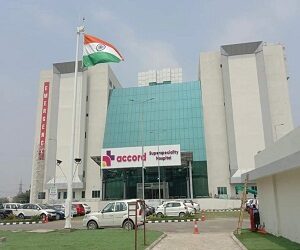
Accord Superspeciality Hospital
Number of beds: 380+
ICU Beds: 41
Airport Distance: 46 Km
About Hospital:
- The story of Accord began with the thought of leveraging the new age technology with the healthcare infrastructure to serve the patients, rightly, effectively, and timely.
- Accord Superspeciality Hospital (A Unit Of SCL Healthcare Pvt. Ltd) is India’s first smart hospital and one of the first of its kind in the world.
- Accord Superspeciality Hospital aims at providing technologically advanced healthcare services to international patients who are looking out for medical tourism in India.
- It delivers world-class patient care services.
- Highly experienced team of super specialist available at accord superspeciality hospital
- It believes in enhancing the expertise of doctors through the use of augmented artificial intelligence, generated through various systems and software.
- Its smartness is the result of a super-brain that accompanies the hospital.

Aakash Health Care Delhi
Number of beds: 230
ICU Beds: 70
Airport Distance: 10 Km
About Hospital:
- Aakash Healthcare Super Speciality Hospital is a tertiary care facility, with 15 Dialysis, and 70 Critical care beds for treating the most complex cases in the National Capital Region (NCR) of Delhi, Dwarka.
- The hospital is equipped with state of the art infrastructure, latest technology, competent clinicians and compassionate staff.
- Aakash Healthcare Super Specialty Hospital is known for its leading care in Orthopaedic and Joint replacement surgery.
- The hospital also has a 24×7 ‘Trauma & Emergency Center’, blood bank, with state of art Neonatal and Paediatric ICU.
- The Super Specialty Hospital is being managed by highly qualified and trained experts from their respective fields and a unified team of healthcare experts ensure 24×7 comprehensive patient care
- The Hospital has deployed high-end technologies and smart digital systems along with robust Hospital Information Systems to address complex medical needs and convenience of patients.
- Mr. J C Chaudhry is the chairman of Hospital and Dr. Aashish Chaudhry is Managing Director, who is also a renowned Orthopedic Surgeon in this region.
- Total number of surgeries done is 25000+ till now.

Jaypee Hospital
Number of beds: 525
ICU Beds : 150
Airport Distance: 32 KMs
About Hospital:
- The Jaypee Hospital was conceptualized by a revered Founder Chairman, Shri Jai Prakash Gaur in 2014, with the vision of promoting world-class healthcare amongst the masses by providing quality and affordable medical care with commitment.
- Jaypee Hospital at Noida is the flagship hospital of the Jaypee Group, which heralds the group’s noble intention to enter the healthcare space.
- This hospital has been planned and designed as a 1200 bedded tertiary care multi-speciality facility and has commissioned 525 beds in the first phase.
- The Jaypee Hospital is constructed across a sprawling twenty-five-acre campus in Sector 128, Noida which is easily accessible from Delhi, Noida and the Yamuna Expressway.
- With its best in class facilities, state-of-the-art technology, diagnostic services, and skilled doctors.
Get Opinion From Doctor
We offers these Services
- Providing a doctor’s opinion and proper quotation
- Selecting the best hospital and doctor as per your case
- Arranging a call with the doctor (if the case required)
- Visa assistance, Providing Visa Invitation Letter (VIL)
- Providing full guidance how to get Visa from your country
- Providing total cost including treatment, air tickets, accommodation, and food
- Assitance to book flight ticket from your country
- Arranging airport pick up/ drop
- Providing professional language interpreter
- Booking accommodation and guest house as per your budget/ prefrence
- Providing help in money exchanging
- Providing local sim card
- Arranging video consultation with specialist doctor if case requires
Treatment
Neuro Hospital Hyderabad
Neuro Surgeon Bangalore
Neuro Surgeon Hyderabad
Neuro Surgeons
Spine Hospital Hyderabad
Best Spine Surgeon
Cervical Spine Surgery
Chronic Spine Back Pain
HDS Treatment
LLFSS Decompression
MINS Surgery BLK-Max
MIS Surgery
Neuro Surgeon In Artemis
Neuro Surgeon In Fortis
Neuro Surgeon In Manipal
Neuro Surgery Treatments
Neuro Treatment Delhi
Neurologist In Asian
Neurologist In Aster CMI
Neurologist In Fortis
Spine Surgery
F.J.S Surgery
P.N Treatment
ASLD Replacement
Spine Osteotomy
Neurologist In Fortis
Neurologist In Fortis
Neurologist In Indraprastha
Neurologist In Jaslok
Neurologist In Jaypee
Neurologist In Kims
Neurologist In Kokilaben
Neurologist In Manipal
Neurologist In Max
Neurologist In Max
Neurologist In Medanta
Neurologist In MGM
Neurologist In Paras
Neurologist In Sarvodaya
Neurologist In Vijaya
Neurologist In Yashoda
Neurology Treatment
Neurology In Manipal
Neurosurgeon In BLK-Max
Neurosurgery In Manipal
LLSS Decompression
DBS Surgery
Meningioma Treatment
S.S Treatment
H.D.S Treatment
Spinal Cord Cancer
SD Surgery
SF Surgery
Spine Fusion Fixation
Lumbar Cervical BLK-Max
Spine Osteotomy
Spine Surgeon In Apollo
Spine Surgeon In Artemis
Spine Surgeon In Aster CMI
Spine Surgeon In BLK-Max
Spine Surgeon In CK Birla
Spine Surgeon In Rela
Spine Surgeon In Fortis
Spine Surgeon In Fortis
Spine Surgeon In Fortis
Spine Surgeon In Indraprastha
Spine Surgeon In Jaslok
Spine Surgeon In Jaypee
Spine Surgeon In Kims
Spine Surgeon In Kokilaben
Meningiomas Treatment
Spinal Fusion Surgery
Herniated Disc Treatment
TLIF Surgery
Osteoarthritis Spine
Spine Surgeon In Manipal
Spine Surgeon In Max
Spine Surgeon In Medanta
Spine Surgeon In MGM
Spine Surgeon In MIOT
Spine Surgeons In Manipal
Spine Surgery
Spine Treatment In Bangalore
Spine Treatment In Chennai
Spine Treatment In Faridabad
Spine Treatment In Gurgaon
Spine Treatment In Hyderabad
Spine Treatment In Mumbai
Spine Treatment Delhi
Spine Tumour Surgery
Neuro Hospital Hyderabad
Spine Hospital Hyderabad
Top Spine Surgeon
Degenerative Disk Spine
Scoliosis Surgery
Spinal Decompression
Minimally Invasive Spine
Spine Tumor Surgery
Spinal Cord Cancer
Top Doctors
Dr. Sandeep Vaishya
Dr. Sumit Batra
Dr. Anil Kumar Kansal
Dr. Sameer Anand
Dr. Nagesh Chandra
Dr. Hamza Shaikh
Dr. Sridhar K
Dr. Hitesh Garg
Dr. Arun Saroha
Dr. Vaibhav Bhola
Dr. P. K. Sachdeva
Dr. Charanjit Singh Dhillon
Dr. Vishal Peshattiwar
Dr. Vineesh Mathur
Dr. Umesh Srikantha
Dr. Kiran Kumar Lingutla
Dr. Suresh Cheekatla
Dr. SK Rajan
Dr. Himanshu Tyagi
Dr. H. S. Chhabra
Dr. B. Mohapatra
Dr. Mukesh Pandey
Dr. Puneet Girdhar
Dr. Ishwar Bohra
Dr. Ankur Nanda
Dr. Rajat Mahajan
Dr. Manoj Sharma
Dr. Saurabh Rawall
Dr. Shishir Kumar
Dr. SAURABH VERMA
Dr. Tarush Rustagi
Dr. Nikhil Jain
Dr. Tarun Kukreja
Dr. Vidyadhara S.
Dr. Thomas J Kishen
Dr. Prakash Singh
Dr. Amitabh Goel
Dr. Ashu Kumar Jain
Dr. Bipin Walia
Dr. Vijayaraghavan G
Dr. Parthasarathy Srinivasan
Dr. Vikas Gupte
Dr. Maulik Patwa
Dr. Praveen Saxena
Dr. Niraj Vasavada
Dr. Ranjith Unnikrishnan
Dr. I. Vishwanatha Reddy
Dr. Naresh Babu J
Dr. Gautam Zaveri
Dr. Rajesh Kumar Verma
Dr. Ram Chaddha
Dr. Manish Kothari
Dr. Pramod Saini
Dr. Kodeeswaran Marappan
Dr. Karthikeyan Y R
Dr. Sundeep V K
Dr. Murali Mohan S
Dr. Ashish Dagar
Dr. S. Karunakaran
Dr. Phani Kiran. S
Dr. Nitin Jagdhane
DR. ANSHU WARADE
Dr. Devashish Sharma
Dr. Akhil Mohandas
Dr. Ticini Joseph
Dr. Arun Bhanot
DR. MIR JAWAD ZAR KHAN
Dr. Uday M Pawar
Dr. Manoj Miglani
Dr. Akhil Tawari
Dr. Sajan K Hegde
Dr. Harnarayan Singh
Dr. Kaviraj Kaushik
Dr. Thomas Joseph Kishen
